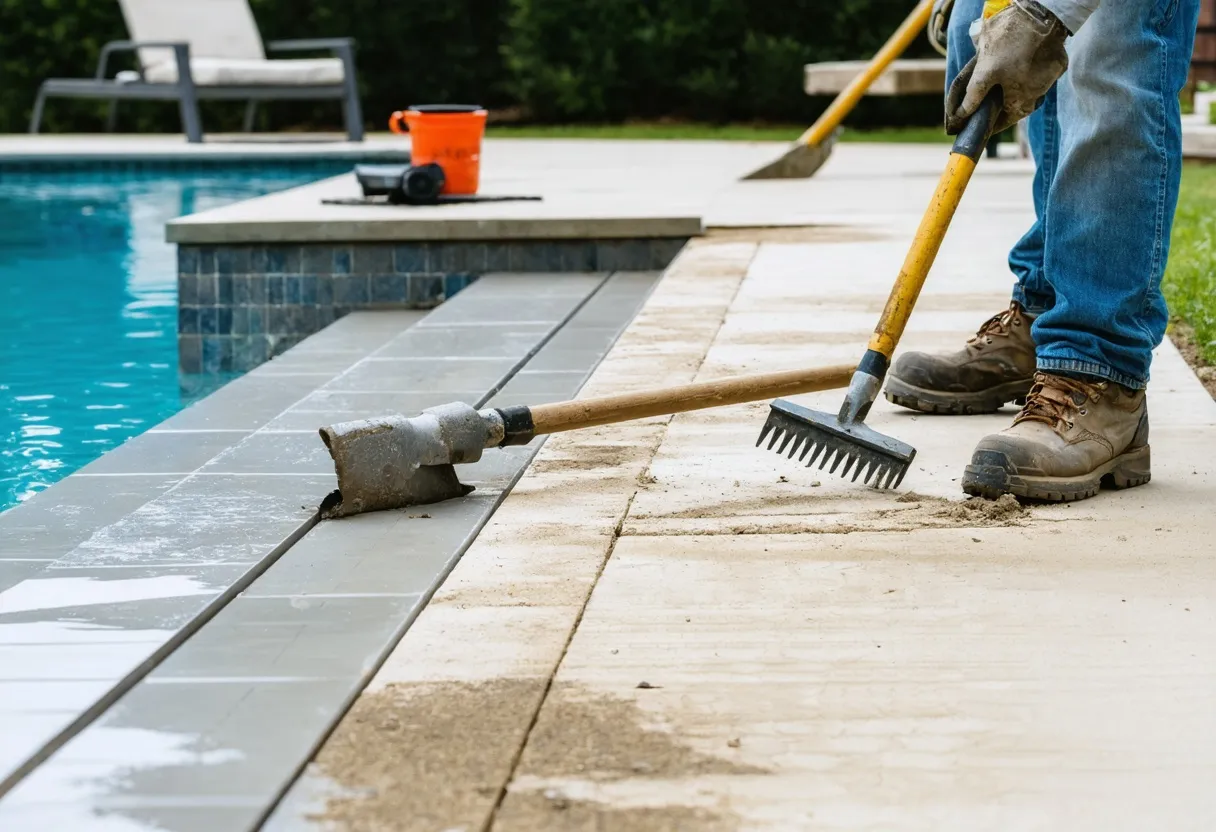
Greenville's pool season runs long and hot, which means the concrete, pavers, or natural stone surrounding your pool get more daily abuse here than almost anywhere in the Southeast. A pool deck in the Upstate has to survive red clay expansion, sudden thunderstorm downpours, and bare feet on 95-degree afternoons — all while looking like it belongs on a magazine cover. That is the gap between a pool contractor who pours a slab and a hardscape team that actually designs for Greenville, SC conditions. This page covers what a complete pool decking and hardscape project involves here, what drives the price, how permitting works across our dual-jurisdiction market, and how to vet a builder before you sign anything.
01What "Pool Decking and Hardscape" Actually Includes
Pool decking is the hard surface immediately surrounding the pool shell — the coping at the water's edge, the walking surface, and any transition zones into the lawn or planting beds. Hardscape is the broader category: retaining walls, seat walls, fire features, outdoor kitchens, paver patios, walkways, and pergola footings that turn a hole full of water into a finished backyard. Most homeowners in Greenville end up needing both, because a pool without a properly graded, properly drained deck is a pool that erodes its own perimeter within a few seasons.
A complete decking and hardscape scope typically covers:
- Excavation and sub-grade compaction sized for the specific soil under your yard
- A drainage plan — channel drains, deck drains, and slope calculations that route water away from the shell and the foundation
- The coping band at the pool edge (bullnose, square-cut, or radius edge depending on the pool type)
- The field material — travertine, paver, stamped concrete, or natural stone — installed over a properly prepared base
- Expansion joints and control joints engineered for our freeze-thaw swings
- Optional extras: sun shelves with integrated decking, seat walls, outdoor kitchen slabs, fire pit pads, and pergola footers
If you're still deciding on the pool shell itself, it's worth reading through our breakdown of gunite pool construction in Greenville before locking in a deck material, since gunite, vinyl, and fiberglass pools each dictate different coping and edge details.
02Pool Patio Design in Greenville, SC: Where to Start
Pool patio design isn't just picking a paver color out of a catalog. A good design session starts with how your family actually uses the backyard — do you want a shaded dining area near the outdoor kitchen, a sun shelf for lounge chairs, a fire feature for cooler Upstate evenings, or a quiet reading nook screened from the neighbors? The layout also has to respect setback lines, existing tree canopy, and the natural slope of the lot, which in much of Greenville means working around grade changes that a flatter market like the Midlands or Lowcountry simply doesn't deal with.
We typically design in three layers:
1. The Wet Deck
This is the band immediately around the water — usually 4 to 6 feet wide — where slip resistance and heat reflectivity matter most. Travertine is popular here because it stays noticeably cooler underfoot than stamped concrete or dark pavers, which matters on a July afternoon in the Piedmont.
2. The Transition Zone
This is where the deck steps down or out into lounge areas, dining space, or a paver walkway back to the house. This is where seat walls, planters, and lighting usually go, and where most of the "wow factor" design decisions get made.
3. The Perimeter
The outer edge where hardscape meets lawn or landscaping. This is also where drainage does the most work — get this wrong and you'll see soil wash-out and settling within a year or two, especially on sloped Upstate lots.
03Pool Types: Gunite, Vinyl, and Fiberglass — and Why It Changes Your Deck
The pool shell you choose directly affects how the deck is built, so it's worth understanding the three main options before you finalize a hardscape plan.
Gunite (Shotcrete) Pools
Gunite pools are sprayed concrete over rebar, built entirely custom to your yard's shape and grade. Because the shell is poured in place, the coping and deck can be tied directly into the structure for a seamless look, and the shape of the pool — free-form, geometric, sun shelf, whatever you want — isn't limited by a mold. Gunite is the most common choice for homeowners who want a fully custom pool patio design in Greenville, since the deck and shell are essentially designed together. For a deeper look at how gunite construction sequences with excavation and steel work, see our page on gunite pool building in the Greenville area.
Vinyl Liner Pools
Vinyl pools use a steel, polymer, or panel wall structure with a fitted liner. They're generally the lowest up-front cost of the three, but the coping detail is different — usually a track-mounted coping piece rather than a poured concrete bond beam — which limits some of the custom edge profiles you can get with gunite.
Fiberglass Pools
Fiberglass shells arrive pre-formed and are set into an excavated hole in one piece. Installation is faster, but the shape is fixed to the manufacturer's mold. Decking still needs full custom design work since the deck is the only part of the project where you get to shape the outdoor space around the fixed shell.
Whichever shell you choose, the decking material and drainage plan should be selected to match it — a fiberglass pool with a wide radius edge needs different coping details than a gunite pool with a vanishing edge or raised bond beam.
04Decking and Hardscape Material Options
This is usually the single biggest design decision after the pool shape itself, since the deck material sets the tone for the entire backyard.
Travertine
Travertine is the most requested premium decking material for Upstate pool projects, and for good reason: it's naturally porous, which keeps it noticeably cooler underfoot in direct sun, it has excellent slip resistance when honed and filled, and it weathers well through our humid summers and occasional winter freezes. As a travertine pool deck installer in Greenville, we set travertine over a compacted, engineered base rather than directly on grade — skipping that step is the single most common shortcut that leads to cracked or heaving pavers within a couple of seasons on our clay-heavy soils.
Concrete Pavers
Interlocking pavers offer the widest range of colors, patterns, and price points, and individual pavers can be replaced if one gets stained or cracked without redoing the whole deck. They're a strong middle-ground option for homeowners who want a custom look without travertine's price tag.
Stamped and Stained Concrete
Stamped concrete gives you a textured, patterned surface (slate, stone, wood-plank looks) poured as one continuous slab. It's typically the most budget-friendly option and has no joints for weeds or ants to work into, but it's a monolithic pour — if it cracks from ground movement, the crack is harder to hide than with modular pavers or stone.
Natural Stone (Flagstone, Fieldstone)
Natural stone gives an irregular, high-end look that pairs well with landscaped, naturalistic pool designs rather than sharp geometric ones. It costs more to install correctly because each piece is fit individually, but it's extremely durable.
Wood and Composite Decking Accents
Less common as the primary wet-deck surface but frequently used for elevated sun decks, pergola flooring, or transition platforms on sloped lots where a hard-surface patio isn't practical at every elevation.
05Upstate Soil, Grading, and Terrain: What Greenville Yards Actually Deal With
This is where a lot of pool decking failures actually start, and it's the part of the process out-of-town contractors tend to underestimate. Much of the Upstate sits on clay-heavy, red Piedmont soil that expands when saturated and contracts when it dries out. Combine that with the rolling terrain typical of Greenville-area lots — far from flat, unlike coastal SC — and you get two compounding problems: unstable sub-grade and gravity-driven water flow that will find every weak point in a poorly designed deck.
Before we design a single square foot of hardscape, we run a grading and drainage assessment specific to your lot. That means:
- Soil testing to confirm compaction requirements and whether structural fill or a geotextile base is needed before decking goes down
- A drainage survey that traces where storm water naturally wants to travel across your yard, so the deck doesn't dam it up against your foundation or your neighbor's fence line
- Slope calculations for the deck surface itself — typically a slight pitch away from the pool and house, sized correctly so it doesn't feel uneven to walk on but still moves water fast enough during a heavy Piedmont thunderstorm
- Retaining wall or terracing plans for lots with meaningful elevation change between the house and the planned pool location, which is common on the sloped lots typical of this market
Skipping this step is the single biggest reason pool decks in this region crack, settle, or pool water where they shouldn't. It's also the step that separates a contractor who understands Upstate SC terrain and soil conditions from one who's just running a standard build sheet.
06Permitting: Navigating Greenville's Dual-Jurisdiction Reality
One thing that surprises a lot of homeowners is that "Greenville" isn't one permitting authority — it's several, depending on exactly where your property sits. A pool and hardscape project inside Greenville city limits goes through different plan review and inspection scheduling than one in unincorporated Greenville County, and if your property falls in one of the surrounding municipalities — Mauldin, Greer, Fountain Inn, or Simpsonville, for example — you may be dealing with that town's own building department instead of the county. Homeowners just outside the core Greenville market, including areas toward Taylors or over the Spartanburg County line, run into the same issue: the permitting authority is determined by the parcel, not by what most people call the area.
A pool and deck permit package generally needs to address:
- Setback compliance from property lines, easements, and septic fields where applicable
- Barrier/fence code requirements around the pool itself, which are non-negotiable safety code items, not design preferences
- Electrical permitting for pumps, heaters, and any lighting or automation tied into the deck
- Drainage and stormwater review, especially on lots that slope toward a neighboring property
- Structural review for any retaining wall over a jurisdiction's height threshold
We handle the permit submission and inspection scheduling as part of the project rather than leaving it to the homeowner to figure out which office to call — but it's worth knowing up front that this is genuinely more complex in Greenville's fragmented jurisdiction map than in a single-city market, and it's one of the reasons timelines can shift by a couple of weeks if a resubmission is needed.
07Pricing and Cost Breakdown
Pool decking and hardscape pricing in the Greenville market is driven by material, square footage, sub-grade conditions, and design complexity — in roughly that order. Rather than quote a single number that doesn't mean much without context, here's how the tiers generally break down:
Entry Tier: Stamped or Broom-Finished Concrete
The most economical option, best suited for straightforward, mostly flat lots with standard drainage needs. This tier gets you a durable, code-compliant deck without premium material or extensive retaining work.
Mid Tier: Concrete Pavers
Adds pattern flexibility, easier spot-repair, and a more custom look. Pricing moves up based on paver grade, pattern complexity (herringbone and basket-weave cost more in labor than a simple running bond), and border/soldier-course detailing.
Premium Tier: Travertine and Natural Stone
The highest material cost per square foot, but also the best heat performance and the longest-lasting finish quality. This is where most full pool patio design projects in Greenville land once homeowners factor in seat walls, an outdoor kitchen slab, or a fire feature.
What Moves the Price Within Any Tier
- Total square footage — the wet deck, transition zones, and any secondary patios all add up
- Sub-grade work — sloped or clay-heavy lots need more excavation, base material, and compaction than a flat, well-drained lot
- Retaining walls and terracing — required on many Upstate lots with meaningful elevation change
- Drainage infrastructure — channel drains, dry wells, or pipe runs to daylight add cost but prevent much larger repair bills later
- Pattern and border complexity — custom inlays, multiple materials, or curved layouts increase labor time
- Add-ons — fire pits, seat walls, outdoor kitchen pads, pergola footings, and lighting conduit
We provide itemized, tier-based quotes rather than a single lump sum, specifically so you can see what's driving the number and where you have room to adjust scope if needed.
08Financing Options
Most homeowners don't pay for a pool and hardscape project entirely out of pocket, and there are a few common paths worth understanding before you start comparing quotes:
- Home equity loans or HELOCs — often the lowest interest rate option if you have equity built up, since the loan is secured against the home
- Pool-specific installment loans — offered through many pool builders' lending partners, typically unsecured and processed faster than a home equity product, though usually at a higher rate
- Cash-out refinancing — worth comparing against a HELOC depending on where current mortgage rates sit relative to your existing loan
- Phased construction — building the pool shell first and phasing the hardscape and deck upgrades in a following season, which spreads cost over time but means living with a temporary deck surface in the interim
We walk through financing partner options as part of the initial consultation so you can compare monthly payment against project scope before committing to a final design — it's much easier to right-size a travertine versus paver decision when you know the actual monthly number, not just the total project cost.
09Construction Timeline and Process
A full pool and decking project in Greenville typically moves through these phases:
- Design and consultation — site visit, soil and drainage assessment, and layout design based on how you'll use the space
- Permitting — plan submission to the correct jurisdiction, structural and setback review, and any revisions needed before approval
- Excavation and shell construction — pool shell installation (gunite, vinyl, or fiberglass) and rough grading of the surrounding deck area
- Plumbing and electrical rough-in — pump lines, drains, and conduit for lighting or automation, all installed before decking goes down
- Sub-base preparation — compaction, geotextile fabric where soil conditions call for it, and base material for the decking
- Coping and decking installation — the coping band goes in first, tied to the pool structure, followed by the field material
- Hardscape features — seat walls, fire features, outdoor kitchen pads, and any retaining work
- Equipment installation and startup — pump, filter, heater, and automation system installation and testing
- Final inspection and water fill — jurisdictional final inspection, then filling and chemical balancing
- Walkthrough — orientation on equipment operation, automation controls, and maintenance basics
Weather is the biggest variable in Upstate timelines — clay soil that's saturated from a wet spring stretch can push back excavation and base compaction by days at a time, since compacting wet clay properly just isn't possible. We build a reasonable weather buffer into every schedule rather than promising a date we can't consistently hit.
10Equipment and Automation Packages
The deck isn't just aesthetic — it's also where most of the wiring and plumbing for your equipment package terminates, so it needs to be planned alongside the technology you want. Common packages include:
- Variable-speed pumps — significantly more energy-efficient than single-speed pumps and quieter, which matters if your patio and outdoor living space sit close to the equipment pad
- Smart automation controllers — app-based control of pumps, heaters, lighting, and water features from a phone, including scheduling that adjusts for seasonal temperature swings
- LED lighting packages — color-changing or fixed-white lighting integrated into the pool wall and, often, into deck steps or seat walls
- Automatic covers — a bigger investment but a meaningful safety and heat-retention upgrade, particularly valuable given how much pollen and debris fall in this region each spring
- Heaters and heat pumps — extend the usable swim season into the shoulder months, which matters more here than in the Deep South since Upstate evenings cool off faster
11Saltwater and Sanitization Systems
Saltwater chlorination has become the default choice for most new pool builds in this market, and for good reason — it produces consistent, lower-concentration chlorine without the harsh smell or skin irritation of manually dosed chlorine, and it reduces the week-to-week maintenance burden significantly. That said, it's not the only option:
- Saltwater chlorine generators — a salt cell converts dissolved salt into chlorine automatically, which is easier to keep balanced and gentler on swimmers and swimwear
- Traditional chlorine systems — lower up-front equipment cost, more hands-on chemical management
- UV and ozone systems — supplemental sanitization that reduces overall chemical demand, often paired with a saltwater system for lower-maintenance water quality
Your sanitization choice also affects decking material selection at the margins — some natural stone finishes are more sensitive to chlorine splash-out over time than sealed travertine or pavers, which is part of why we walk through equipment and material choices together rather than as two separate conversations.
Get your free quote
Tell us about your property and we'll follow up with next steps — no pressure, no obligation.
Ready to see what your site needs?
Get a free, no-obligation quote built around your property's actual conditions.