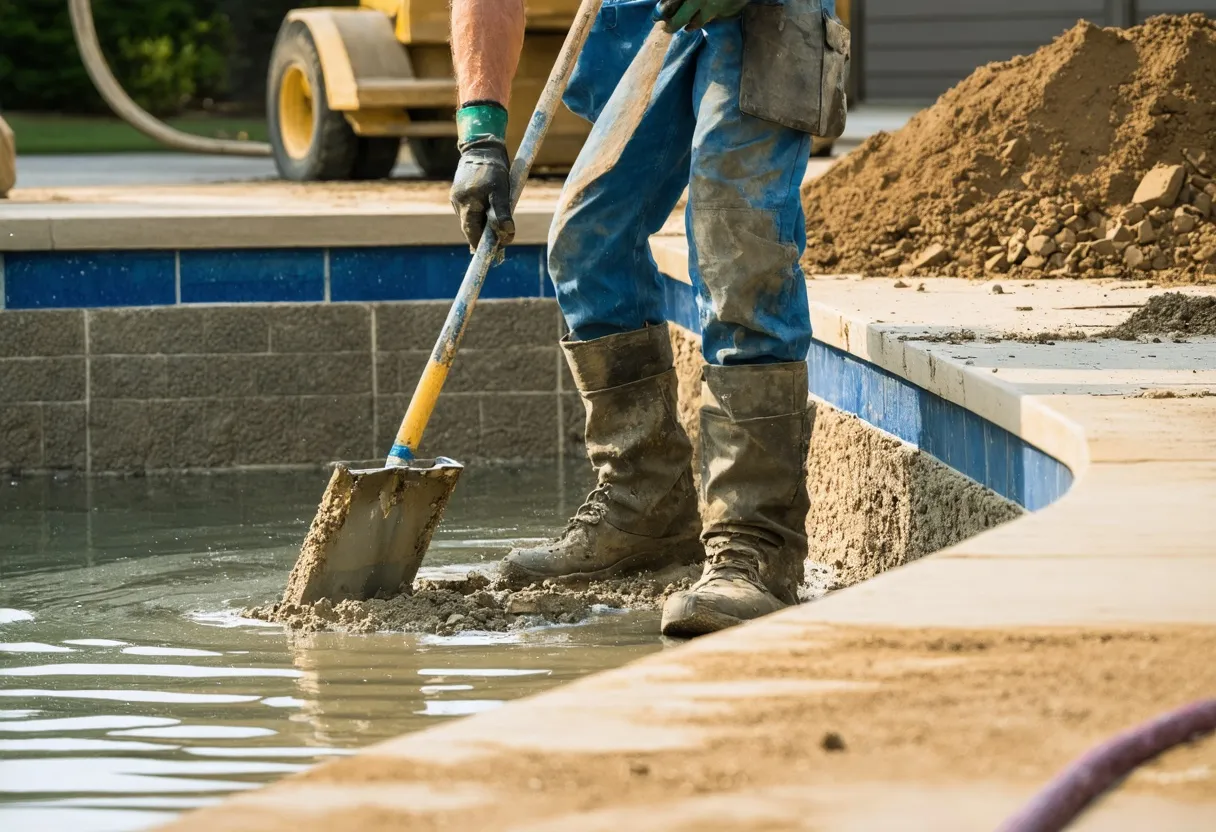
A gunite pool builder in Greenville, SC isn't solving the same problem a builder on flat coastal sand is solving. Between Congaree Rd and the rest of the city, out through Simpsonville, Taylors, Mauldin, Greer, Anderson, and Fountain Inn, most Upstate backyards sit on rolling Piedmont grade over clay-heavy soil that swells and shrinks with the season — and that ground condition, more than any shape on a brochure, is what determines whether a gunite shell holds up for decades or starts cracking and settling within ten years. Gunite is the material that lets a pool be engineered to that ground and shaped to your yard, rather than forcing your yard to accept a pre-molded shell it was never graded for.
This page is written for homeowners specifically comparing gunite pool builder Greenville SC proposals, not generic "get a pool" content. It covers how terrain and soil should actually change your engineering spec, how permitting splits between Greenville city limits and Greenville County, what separates a real pricing tier from a lowball lump sum, and what licensing and PHTA-aligned training should mean to you before you sign anything.
01What a Real Gunite Specialist Brings to a Greenville Lot
02Building a Gunite Shell for Greenville's Clay and Grade
Most national pool-company sales material is written for sandy coastal ground, and it shows the moment it meets Upstate soil. The clay found across Greenville-area lots — from the older neighborhoods near Congaree Rd to newer builds out toward Simpsonville and Taylors — expands when it's wet and pulls back tight when it dries out. That cycle puts ongoing pressure on anything set into it, including a gunite shell, its plumbing runs, and the decking tying into it. Add the rolling grade common to Upstate lots and you get two variables that have to be measured before a design is finalized: how much weight the soil under the shell can actually bear, and where water on your property wants to go once the yard is disturbed.
What that means for your build
A gunite crew that treats every lot the same — same rebar cage, same shell thickness, same drainage plan regardless of what's underneath — is deferring a problem to year five or ten, well past the point of an easy fix. A gunite specialist working Greenville ground on purpose does a site-specific soil and grade read before engineering is locked, sizes the steel and shotcrete thickness to that read, and builds positive drainage around the entire pool and deck perimeter so water moves away from the shell and your foundation instead of pooling against either. On sloped lots — common in Greer, Mauldin, and parts of Fountain Inn — that also means engineered fill or a proper retaining structure instead of simply cutting into the slope and hoping the grade holds.
None of this is optional scope you can trim to save money without consequence. It's the difference between a shell that's still performing at year thirty and one that's cracking, settling, or fighting drainage problems well before the plaster even needs its first refinish.
03Permitting a Gunite Pool Across Two Jurisdictions
Before your gunite design is finalized, we confirm whether your address sits inside Greenville city limits or unincorporated Greenville County, since each authority runs its own submission and inspection sequence layered on top of South Carolina's building code and the ISPSC.
Structural drawings reflecting your site's soil evaluation, rebar spec, and shell thickness go to the right jurisdiction the first time, along with any HOA approval your neighborhood requires.
Self-closing gate hardware, minimum fence height, and door-alarm requirements are built into the permit application from the start so a finished gunite shell isn't stalled at final inspection over an enclosure detail.
Steel, plumbing, shell, and pre-plaster inspections are scheduled around how long the gunite actually needs to cure, rather than rushed to fit a jurisdiction's inspection queue.
Projects in Mauldin, Greer, Anderson, or Fountain Inn get checked against that municipality's own pool ordinance before the construction schedule is set, since a few miles can mean a different rulebook.
04Gunite Pricing Tiers and Financing, Without the Guesswork
Gunite pricing conversations go wrong fast when two quotes aren't broken into the same categories, so here's how we structure a proposal instead of handing over one lump number.
Foundation tier
A geometric or simple freeform shell on a flat, easy-access lot with standard plaster finish and a base equipment package. This tier reflects straightforward excavation and shorter forming time, not a stripped-down shell — the same soil evaluation and engineering rigor applies regardless of tier.
Elevated tier
Freeform shapes, tanning ledges, upgraded pebble or quartz finishes, and moderate site difficulty — a gentle slope, average access, or a modest drainage plan — move a project into this middle band.
Signature tier
Negative edges, integrated spas, extensive custom decking or outdoor living hardscape, and harder sites — steep grade, tight equipment access, engineered retaining walls — sit here, since both design complexity and site engineering scale together.
Because size, shape, finish, equipment tier, and site difficulty all interact, the tier a project lands in has more to do with your lot and design goals than with a single square-footage number. On the financing side, most Greenville-area buyers use a home equity loan or HELOC where equity is available, an unsecured pool loan through a third-party lender when it isn't, or in some cases builder-arranged financing. Each option trades rate, approval speed, and how draws line up with your construction payment schedule differently, and the right one depends on your equity position and credit profile more than on the pool itself.
05Licensed and PHTA-Informed, Not Just Sales-Trained
South Carolina requires the appropriate state contractor's license to build pools, and construction standards informed by Pool & Hot Tub Alliance training go beyond that baseline into water chemistry, structural detail, and code compliance specific to pools. Ask any builder you're comparing to show both before you sign — it's a reasonable question, not an unusual one.
06Gunite Pool Builder Greenville SC: Common Questions
Gunite is formed on site rather than dropped in as a pre-made shell or panel system, so it's the only option that can be engineered to Upstate clay and rolling grade rather than fitted to a manufacturer's mold or panel catalog. Fiberglass and vinyl remain reasonable choices on flatter, easier lots or tighter budgets, but they have less room to be adjusted for difficult drainage or grading.
Soil and grade evaluation happens during design, before engineering is finalized, and feeds directly into your rebar and shell-thickness spec. Exact scope depends on your lot and shows up as its own line in a tiered, itemized proposal rather than being buried inside a single lump-sum number.
Possibly — rainy stretches during excavation or curing are the most common source of schedule slippage on Upstate gunite projects, which is why a realistic timeline builds in buffer instead of promising an aggressive best-case date as a guarantee.
Yes, including Simpsonville, Taylors, Mauldin, Greer, Anderson, and Fountain Inn. Each of those falls under its own local permitting layer in addition to the city-versus-county split inside Greenville itself, which gets confirmed before design is locked.
A tier reflects shape complexity, finish, equipment level, and site difficulty together, broken into categories you can compare against a competing quote line by line — instead of two builders' "starting at" numbers that may not include the same site prep or engineering scope at all.
Get your free quote
Tell us about your property and we'll follow up with next steps — no pressure, no obligation.
Ready to see what your site needs?
Get a free, no-obligation quote built around your property's actual conditions.