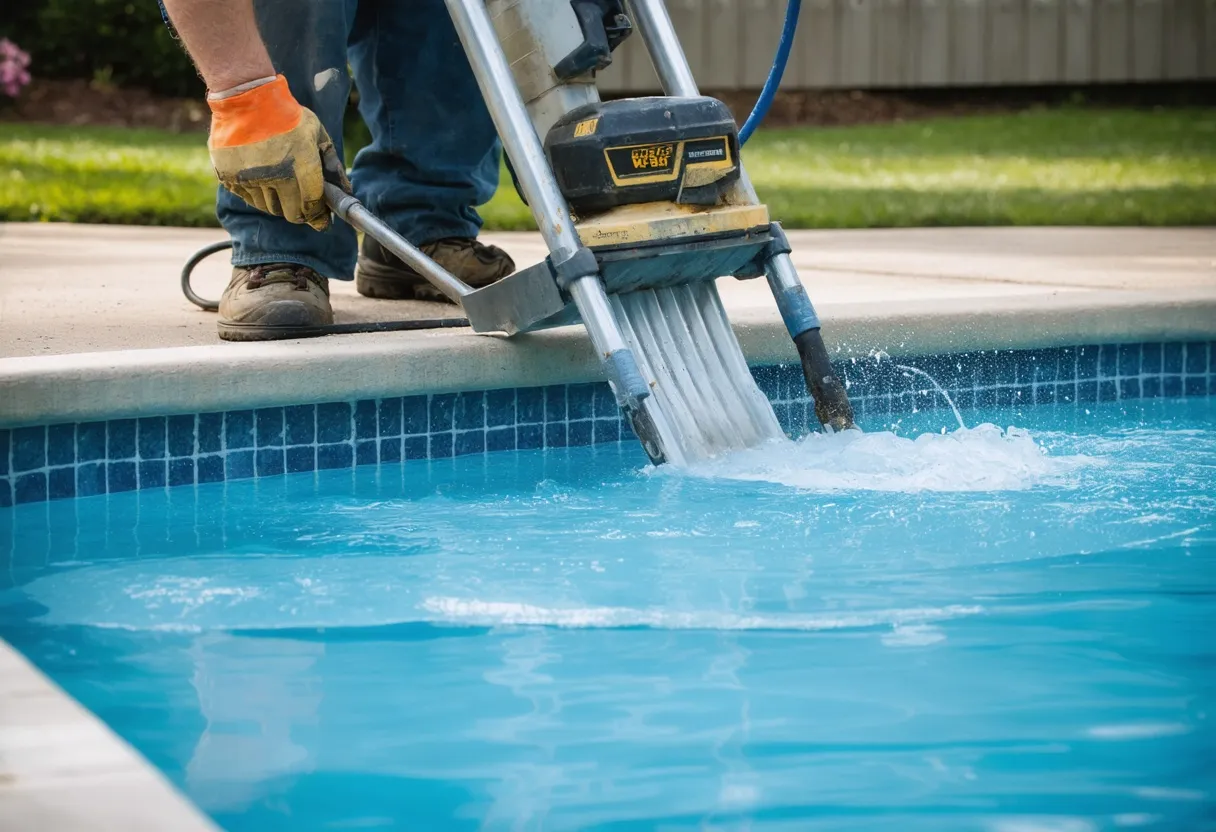
Building a swimming pool in the Upstate isn't the same project as building one in the Lowcountry or the Midlands. Greenville's red clay soil, rolling Piedmont grade changes, and split city/county permitting rules all shape how a pool gets designed, engineered, and installed. If you're comparing quotes from a pool builder in Greer, SC or looking for an experienced inground pool contractor anywhere across the Greenville market, the details that matter most rarely show up on a glossy brochure: soil conditions, permit jurisdiction, equipment specs, and what actually drives your final number up or down.
This page walks through everything a homeowner needs to evaluate before signing a contract — pool types, real cost drivers, financing, the permitting process across Greenville-area jurisdictions, construction timelines, equipment packages, decking, spas, ongoing maintenance, and how to vet a builder's licensing and credentials. We serve homeowners throughout the Piedmont, including Greenville-area pool construction projects from Greer to Simpsonville, Taylors, Mauldin, Anderson, and Fountain Inn.
01Why Terrain and Permitting Rigor Matter Here
Two pools built to identical blueprints can cost differently and finish on different schedules depending on where they sit in the Upstate. Soil composition across Greenville County varies from workable clay loam to shelf rock and high water tables, and grade changes common to Piedmont lots mean excavation, retaining structures, and drainage planning aren't optional add-ons — they're baked into the design from day one. A builder who treats every lot the same way, without a pre-construction soil and grading assessment, is the most common source of mid-project change orders and delays.
Permitting compounds this. Depending on your address, your project may fall under the City of Greenville's building department, unincorporated Greenville County, or a neighboring county's jurisdiction entirely — each with its own setback rules, fencing/barrier codes, electrical bonding requirements, and inspection sequencing. A pool contractor who pulls permits daily in this specific dual-jurisdiction environment moves faster than one learning the local rules on your project's dime.
02Pool Types: Gunite, Vinyl, and Fiberglass
Every pool style has legitimate tradeoffs. The right choice depends on your budget, timeline tolerance, design goals, and how much long-term maintenance you're willing to take on.
Gunite (Shotcrete) Pools
Gunite pools are built by spraying a wet concrete mixture over a steel rebar framework, then finishing the shell with plaster, pebble, or quartz aggregate. This method offers the most design freedom of any pool type — custom shapes, tanning ledges, vanishing edges, integrated spas, and virtually any depth configuration are possible. Because the shell is formed on-site, gunite construction is also the most sensitive to soil and grading conditions; rebar engineering and excavation depth both need to account for Piedmont clay behavior and any rock encountered during dig-out. Gunite is generally the slowest pool type to build and the highest-maintenance long term, since the surface finish needs periodic resurfacing, but it's the standard choice for homeowners who want a fully custom, resort-style backyard.
Vinyl Liner Pools
Vinyl liner pools use a welded, custom-cut liner stretched over a wall structure (steel, polymer, or a hybrid panel system) with a compacted sand or vermiculite floor. They're typically the lowest up-front cost of the three main pool types and can still be built in a wide range of shapes. The tradeoff is the liner itself — it needs periodic replacement (typically every 7-12 years depending on water chemistry and sun exposure), and the smooth vinyl surface is more prone to punctures or wrinkles than a rigid shell. For budget-conscious homeowners who want shape flexibility without gunite pricing, vinyl remains a solid option.
Fiberglass Pools
Fiberglass pools arrive as a pre-manufactured one-piece shell that's craned into an excavated hole, set on an engineered base, and backfilled. Because the shell is built off-site in a controlled factory environment, installation timelines are dramatically shorter than gunite, and the smooth gel-coat surface resists algae growth better than either concrete or vinyl, which typically translates to lower chemical and cleaning costs over time. The tradeoff is shape and size limitation — you're choosing from a manufacturer's mold catalog rather than a fully custom design. For a full breakdown of shell options, shapes, and installation specifics, see our dedicated guide to fiberglass pool installation in the Greenville area.
None of these three types is universally "best" — a good contractor will walk your specific lot, review your soil and grading conditions, ask about your design priorities, and recommend the type (or combination, such as a fiberglass pool with a gunite spa) that fits your site and goals rather than pushing whichever product line they happen to install most.
03What Drives Pool Cost in the Greenville Market
Pricing a pool honestly means walking through the variables that move the number, rather than quoting a flat figure that doesn't hold up once excavation starts. The biggest cost drivers we see on Upstate projects are:
- Pool type and shell material — vinyl liner construction generally carries the lowest base cost, fiberglass sits in the middle with faster installation offsetting shell cost, and gunite carries the highest cost due to labor-intensive on-site forming, rebar, and finish work.
- Size and depth — every additional square foot of surface area and every foot of added depth increases excavation, material, and water volume costs proportionally.
- Site access and grading — a flat, easily accessible backyard costs less to build on than a sloped lot requiring retaining walls, extended equipment reach, or engineered fill. Piedmont lots with meaningful grade change from house to pool site often need retaining structures that aren't part of a base pool price.
- Soil and rock conditions — Upstate soil is not uniform. Some lots dig cleanly through clay; others encounter partial rock or high water tables that require different excavation equipment or dewatering measures. This is exactly why a pre-construction soil assessment matters — it lets a builder price rock-contingency realistically instead of leaving it as a surprise change order.
- Decking and hardscape scope — a minimal concrete apron costs far less than a full paver or travertine patio with a seating wall, outdoor kitchen pad, or fire feature.
- Equipment and automation selections — variable-speed pumps, saltwater chlorination, heat pumps, and app-based automation all add to the equipment package cost but reduce long-term operating expense.
- Permitting jurisdiction — fencing/barrier requirements, setback rules, and inspection sequencing differ by jurisdiction and can add scope (for example, additional fencing footage or engineered barrier gates) that isn't identical from one Greenville-area municipality to the next.
- Add-ons — an attached spa, tanning ledge, water features, or a vanishing edge each add distinct labor and material cost on top of the base pool.
Because these variables swing the final number so significantly, we don't publish a single "average pool price" — it would be misleading for anyone comparing an entry-level vinyl liner install to a full custom gunite project with an attached spa and a paver patio. Instead, we walk every prospective client through a site-specific estimate that accounts for your actual lot, soil conditions, and design goals. For a detailed look at how pricing tiers break down by pool type and what payment structures are available, visit our pool cost and financing guide.
04Financing Your Pool
Most homeowners finance at least part of a pool project rather than paying entirely in cash, and there are several structures worth comparing before you commit to one:
- Home equity loans or HELOCs — often the lowest interest rate option for homeowners with sufficient equity, since the loan is secured by the property.
- Unsecured pool loans — offered through third-party lenders that specialize in home improvement financing; faster approval, no equity required, typically a higher rate than a HELOC.
- Builder-arranged financing — some contractors partner directly with lenders and can pre-qualify you during the estimate process, which simplifies the timeline.
- Cash-out refinancing — folds the pool cost into a new mortgage, which can lower the effective monthly payment but extends the payoff timeline over the life of the mortgage.
The right structure depends on your equity position, credit profile, and how the monthly payment fits your budget alongside ongoing maintenance costs. Our full comparison of financing paths, including how loan terms interact with different pool pricing tiers, is on the Greenville pool cost and financing page — it's worth reviewing before your first design consultation so you walk in knowing your realistic budget range.
05Design and Customization
Design is where a pool goes from "a hole full of water" to a backyard people actually use every day. Customization decisions typically include:
- Shape and layout — geometric (rectangle, Roman end, L-shape) reads more formal and suits smaller or narrower lots; freeform shapes suit larger lots and naturalistic landscaping.
- Depth profile — a shallow, uniform "play depth" pool suits families with young kids; a deep-end/diving profile suits swimmers and divers; a zero-entry or beach-entry design suits accessibility and lounging.
- Tanning ledges and sun shelves — shallow, submerged platforms near the entry for loungers or kids' play, now a standard request on most custom builds.
- Water features — deck jets, sheer descents, bubblers, and waterfalls add visual and audible interest but also add pump and plumbing complexity.
- Lighting — LED color-changing lights are now standard on most new builds and integrate with the same automation system controlling pumps and heaters.
- Vanishing edges and raised walls — dramatic on sloped lots with a view, but require additional structural engineering — another reason grading assessment happens before design finalization, not after.
Good design also means designing for your specific yard, not a stock rendering. On Piedmont lots with slope, a design that ignores the grade change usually costs more to build than one that works with it — for instance, orienting the pool to use excavated soil as backfill for a raised patio area rather than trucking it off-site.
06Permitting and Soil/Terrain Conditions in the Upstate
This is the step where projects most often go sideways with inexperienced builders, so it deserves a detailed walkthrough.
Dual-Jurisdiction Permitting
Depending on your specific address, your pool permit may be processed by the City of Greenville, unincorporated Greenville County, or a neighboring county's building department. Each jurisdiction sets its own requirements for setbacks from property lines and septic fields, pool barrier/fencing specifications, electrical bonding and grounding inspections, and the sequencing of inspections (excavation, steel/plumbing rough-in, electrical, and final). A permit application that's correct for a Greenville County lot isn't automatically correct once you cross into a different jurisdiction, so confirming the applicable authority before submitting plans avoids delays that can stall a project for weeks.
Soil and Grading Assessment
Upstate South Carolina soil is not uniform. Depending on the lot, excavation can move cleanly through clay loam or encounter partial rock shelf, dense fill, or a seasonally high water table. Grade change is also a factor on much of the rolling Piedmont terrain common across the region — a backyard that slopes even modestly from the house to the property line changes how excavation, retaining walls, and drainage are planned.
Before finalizing a design, we recommend (and perform) a site-specific soil and grading review rather than pricing off a satellite photo. This lets your contract reflect the actual dig conditions on your lot instead of treating rock encounters or drainage rerouting as a surprise change order mid-project. It's also why we encourage homeowners to be skeptical of any quote issued without a site visit — a number quoted sight-unseen is a guess, not an estimate.
Drainage Planning
Pool construction changes how water moves across a property. Excavation, decking, and any retaining structures need to route surface water away from the pool shell, the house foundation, and neighboring lots — particularly important on sloped Piedmont yards where poor drainage planning during construction can create runoff problems well after the pool is finished.
07Construction Timeline and Process
A realistic construction sequence, start to finish, generally follows these stages:
- Site visit and soil/grading assessment — evaluating your yard's access, slope, drainage pattern, and general soil condition before design begins.
- Design and contract — finalizing shape, depth, equipment package, decking, and any add-ons (spa, water features), followed by a detailed written contract with a specific scope of work.
- Permitting — submitting plans to the correct jurisdiction, addressing any plan review comments, and securing approval before excavation begins.
- Excavation — digging the pool to design depth and profile; this is the stage most affected by the soil conditions identified in the assessment phase.
- Steel and plumbing rough-in — for gunite pools, rebar is set to the engineered specification; for all pool types, plumbing lines for skimmers, returns, and drains are run and pressure-tested before they're covered.
- Shell installation — gunite is sprayed and cured; a fiberglass shell is set by crane onto its prepared base; a vinyl liner's wall structure is assembled and the floor is troweled.
- Decking and hardscape — concrete, pavers, or stone is installed around the pool perimeter once the shell is set and backfilled.
- Equipment installation — pump, filter, heater, sanitization system, and automation controls are installed and plumbed into the equipment pad.
- Interior finish — plaster, pebble, quartz finish (gunite), or liner installation (vinyl), followed by initial fill.
- Startup and inspection — water chemistry is balanced, equipment is tested, and the final inspection confirms the barrier/fencing and electrical work meets code before the pool is cleared for use.
Weather, permit review timelines, and soil conditions encountered during excavation are the three biggest variables affecting how long this sequence actually takes on a given project — which is another reason an accurate, site-specific assessment up front produces a more reliable schedule than a generic timeline quoted before anyone has seen your yard.
08Equipment and Automation Packages
The equipment pad is where long-term operating cost and convenience get decided. Core components include:
- Pumps — variable-speed pumps cost more up front than single-speed models but run at a fraction of the energy draw, which typically pays back the price difference over a few years of operation.
- Filtration — cartridge, sand, and diatomaceous earth (DE) filters each have different maintenance schedules and filtration fineness; cartridge systems are common on new residential builds for their lower maintenance.
- Heating — heat pumps are the most energy-efficient option for extending the swim season in the Upstate's climate; gas heaters heat faster but cost more to run.
- Automation — app-based controllers now let homeowners manage pump schedules, heating, lighting, and sanitization remotely from a phone, and can integrate with smart home systems.
Choosing the right equipment package is a balance between up-front budget and the operating costs you'll carry for the life of the pool — a lower-cost single-speed pump might save money at installation but cost meaningfully more in electricity every month afterward.
09Saltwater and Sanitization Systems
Sanitization keeps a pool safe to swim in, and there are a few established approaches:
- Saltwater chlorination — a salt cell converts dissolved salt into chlorine automatically, producing more consistent chemical levels and softer-feeling water than manual chlorine dosing. It's the most requested system on new residential builds because it reduces (though doesn't eliminate) manual chemical handling.
- Traditional chlorine — tablet or liquid chlorine dosing remains reliable and has the lowest equipment cost, but requires more hands-on monitoring and adjustment.
- UV and ozone systems — supplemental sanitization methods that reduce chlorine demand and can be paired with either saltwater or traditional chlorine systems for additional water clarity.
Whichever system you choose, proper circulation and filtration sizing matter as much as the sanitization method itself — an undersized pump or filter will struggle to keep water clear no matter how good the chemical system is.
10Decking and Hardscape
The deck does more than look good — it's the surface you'll actually stand on barefoot in July, and it needs to handle Upstate weather without becoming a maintenance headache. Common options include:
- Stamped or broom-finished concrete — the most budget-friendly decking option, available in a range of textures and colors.
- Pavers — individual units that can be replaced piecemeal if damaged, with a wide range of pattern and color options; a popular mid-to-upper tier choice.
- Natural stone (travertine, flagstone) — premium look and heat-resistant underfoot, at a higher material and installation cost.
Beyond the decking material itself, hardscape scope often includes retaining walls (particularly relevant on sloped Piedmont lots), seating walls, outdoor kitchen pads, fire features, and covered structures. Because decking sits directly on or adjacent to the same soil that was excavated for the pool, proper compaction and drainage beneath the deck matters as much as the surface material — poorly compacted base is one of the most common causes of cracked or settling decking down the road.
11Spas and Hot Tubs
An attached spa is one of the most requested add-ons on new pool builds — it extends usable months into cooler weather and gives the yard a second focal point beyond the pool itself. Spas can be built in-ground and structurally attached to the pool (sharing a wall with a spillover edge into the pool), or built as a standalone raised spa. Attached spas typically share the pool's equipment pad but run on separate heating and circulation so the spa can be heated and used independently of the main pool. For a closer look at spa and hot tub design options, heating specifics, and how they integrate with a new or existing pool, see our spa and hot tub page.
Get your free quote
Tell us about your property and we'll follow up with next steps — no pressure, no obligation.
Ready to see what your site needs?
Get a free, no-obligation quote built around your property's actual conditions.