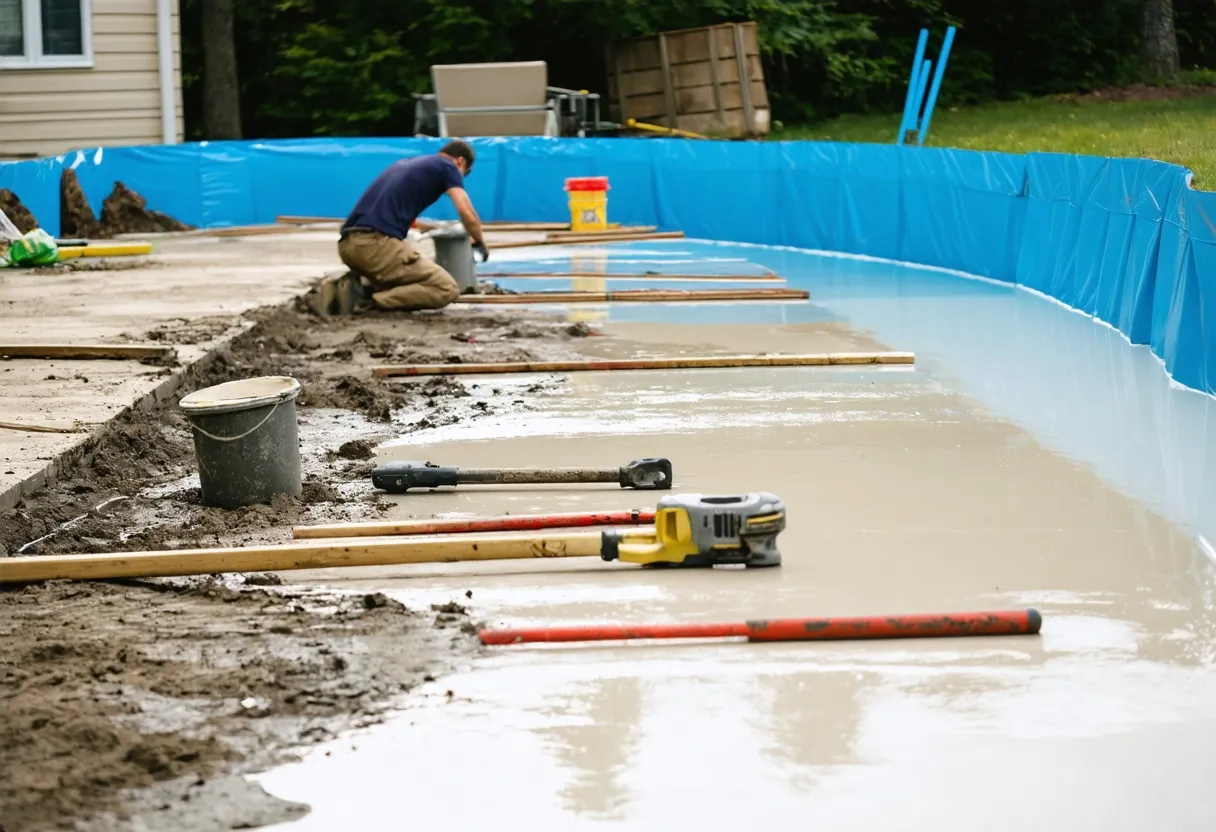
Fiberglass pool installation in Greenville, SC typically runs $55,000 to $95,000+ installed, and the single biggest variable in that range isn't the shell you pick — it's what's under your yard. Greenville sits in the Piedmont region, where thin topsoil over rock and clay, mixed grading across older and newer subdivisions, and two separate permitting authorities (City of Greenville and Greenville County) all shape how a project gets built, how long it takes, and what it costs. A page that just lists shell colors and skips that part isn't giving you the full picture. This one covers both: the fiberglass installation process itself, and the Greenville-specific terrain and permitting realities that determine whether your project stays on budget.
Whether you're comparing fiberglass pool cost and financing options in Greenville SC for the first time or you've already got a few contractor quotes in hand and want to know what's driving the spread between them, this guide walks through pool types, the full installation timeline, permitting and soil conditions, equipment and sanitization choices, decking, spas, ongoing maintenance, and how to vet a builder before you sign a contract.
01Fiberglass vs. Gunite vs. Vinyl: Which Pool Type Fits Greenville Yards
Every Greenville pool builder installs some combination of three shell types, and each behaves differently once it's in Upstate South Carolina ground.
Fiberglass Pools
A fiberglass pool arrives on-site as a single pre-molded shell and is set into an excavated hole in one day. That's the core advantage: fast installation (typically 3-6 weeks total from dig to swim, versus 8-14+ weeks for gunite), a smooth gelcoat surface that resists algae growth, and lower long-term chemical and maintenance costs because the non-porous surface doesn't need re-plastering every 10-15 years the way gunite does. The tradeoff is shape flexibility — you're choosing from a manufacturer's mold lineup rather than a fully custom outline, and shell sizes are capped by what can legally travel on a truck to the site.
Gunite (Shotcrete) Pools
Gunite pools are sprayed-in-place concrete, built to any shape, depth, or feature you can design — vanishing edges, custom tanning ledges, irregular free-form outlines. That customization comes with a longer build (concrete curing alone adds weeks), a rougher plaster surface that's more algae-prone and needs periodic acid washing or resurfacing, and generally the highest price point of the three. Gunite makes sense when the design calls for something a mold genuinely can't replicate.
Vinyl Liner Pools
Vinyl liner pools use a steel, polymer, or aluminum wall structure lined with a custom-cut vinyl sheet. They offer more shape flexibility than fiberglass at a lower upfront cost than gunite, but the liner itself is a wear item — expect to replace it roughly every 7-12 years, and liners are more vulnerable to punctures from pets, tree roots, or sharp pool toys. It's a reasonable middle-ground choice for buyers prioritizing initial cost over 20-year total cost of ownership.
For most Greenville homeowners weighing installation speed, ground disruption, and lifetime maintenance against upfront price, fiberglass lands as the best balance — which is why it's the focus of the rest of this guide. But an honest builder will walk you through all three against your actual yard and budget rather than pushing one shell type by default.
02What's Included in a Fiberglass Pool Installation
A complete fiberglass pool installation is a lot more than "drop the shell in the hole." A full-scope project includes:
- Site evaluation, soil testing, and utility locates
- Design and engineering, including shell selection, placement, and orientation
- Permit applications and inspections through the correct local jurisdiction
- Excavation sized and shaped to the shell's engineering specs
- Plumbing rough-in for skimmers, returns, main drains, and any water features
- Shell placement, leveling, and backfill (typically with a stabilizing material like crushed stone or flowable fill rather than plain native soil)
- Electrical rough-in for pumps, lighting, and automation, run to code and bonded/grounded per National Electrical Code Article 680
- Equipment pad installation — pump, filter, heater, sanitization system
- Decking and coping
- Fencing or an approved barrier system where required
- Final inspections, water fill, startup, and chemical balancing
Any quote that skips line-item detail on these — especially backfill material, electrical bonding, and inspection scheduling — is a quote you should ask more questions about before signing.
03The Installation Process, Step by Step
1. Site Visit and Soil Assessment
A qualified builder walks the yard before drawing anything, checking slope, drainage patterns, tree root proximity, existing hardscape, and access for excavation equipment. In the Upstate, this step matters more than in flatter coastal markets — Piedmont terrain runs from gently rolling to steeply graded within the same neighborhood, and the same excavation plan doesn't work uniformly across Greenville lots. For a deeper walkthrough of what this assessment covers and why it drives both design and cost here, see our Greenville soil and permitting guide.
2. Design and Contract
Shell shape, size, depth configuration, and placement get finalized, along with equipment selections, decking material, and any add-ons like a spa or sun shelf. A detailed contract should specify exact shell model, all included equipment by brand and model, backfill material, decking scope, and a payment schedule tied to project milestones — not a flat deposit-then-balance structure.
3. Permitting
Permits get submitted to the correct jurisdiction — a distinction that trips up a surprising number of Greenville homeowners, since a property just outside city limits falls under Greenville County review with different setback and barrier requirements than one inside the City of Greenville. Fence and barrier compliance (self-closing, self-latching gates; minimum height requirements) gets reviewed at this stage too, and it's typically a separate inspection from the pool structure itself. Permit review timelines vary by jurisdiction and season, so this step should be built into your schedule up front rather than treated as a formality.
4. Excavation
Equipment digs a hole matched precisely to the shell's engineered dimensions, with allowance for backfill material around the perimeter. Excavated soil across the Piedmont commonly includes a shallow topsoil layer over clay-heavy subsoil, and in some areas partially weathered rock closer to the surface than homeowners expect. Unexpected rock can mean supplemental equipment or extra excavation time, which is why a pre-dig soil assessment — rather than a surprise mid-dig — protects your timeline and budget.
5. Plumbing and Electrical Rough-In
Pipe runs for skimmers, returns, and drains get installed and pressure-tested before the shell goes in, and electrical conduit is run to code for pump, lighting, and automation circuits.
6. Shell Setting
The fiberglass shell is craned or winched into the hole, leveled precisely, and braced. This is typically a single-day operation and one of the most visually dramatic parts of the build for homeowners watching the process.
7. Backfill and Plumbing Connection
Backfill material is placed and compacted in stages around the shell to stabilize it evenly and prevent shifting, while plumbing lines are connected to the shell's fittings. Backfill choice matters more on Piedmont clay soils, which expand and contract with moisture more than sandy soils do — using an appropriate stabilizing backfill rather than reusing native clay is one of the details that separates a durable installation from one prone to shell movement over time.
8. Decking, Coping, and Equipment Pad
Concrete, pavers, or another decking material gets poured or set around the pool, coping is installed at the shell's edge, and the equipment pad (pump, filter, heater, sanitization system) is built out and connected.
9. Fencing and Barrier Compliance
Any required pool barrier or fencing is installed to meet code, including self-closing and self-latching gate hardware.
10. Final Inspection, Fill, and Startup
Once local inspectors sign off, the pool is filled, equipment is started up, and initial water chemistry is balanced. A good builder walks you through basic operation, filter cleaning, and automation controls before calling the project complete.
Total timeline for a straightforward fiberglass install typically runs 3-6 weeks from permit approval to first swim, though permitting lead time, weather, and soil surprises can extend that. Builders juggling multiple jurisdictions across the greater Greenville area — including work in Simpsonville, Taylors, Spartanburg, Mauldin, Greer, Anderson, and Fountain Inn — tend to have a realistic sense of how permit timelines actually run in each area, which is worth asking about directly when you're comparing quotes.
04Permitting and Soil/Terrain Conditions in Greenville
This is the part of the process most cost overruns trace back to, and it's specific to where you're building — not something a generic national pool-cost article can tell you.
Dual-Jurisdiction Permitting
Depending on your property's exact location, your pool permit is reviewed either by the City of Greenville or by Greenville County, and the two don't apply identical requirements for setbacks, barrier specifications, or inspection sequencing. A property that looks like it's "in Greenville" for everyday purposes may actually sit outside city limits and fall under county jurisdiction, or vice versa. Confirming which authority governs your property before finalizing your design avoids a redesign after you've already submitted plans. Our dual-jurisdiction permitting guide for Greenville pool projects breaks down how to check your jurisdiction and what each one typically requires.
Upstate Soil and Grading
Greenville sits in the Piedmont, and Upstate South Carolina terrain and soil conditions differ meaningfully from the sandy coastal soils most national pool-cost guides are written around. Piedmont lots commonly combine clay-heavy subsoil with rolling to sloped grading, and the specific mix varies lot to lot — some yards excavate cleanly, others hit denser clay or shallow rock that adds equipment time. What this means practically:
- A pre-construction soil assessment is worth insisting on, not skipping, since it's the main defense against mid-project surprises
- Sloped lots may need retaining walls, additional grading, or engineered drainage — all of which are cost drivers to price in up front, not after excavation starts
- Backfill material should be chosen for the soil conditions on your specific lot rather than applied as a one-size-fits-all default
- Drainage planning around the pool and decking matters more on clay-heavy ground, since clay drains slower than sandy soil and standing water near a shell or deck footing is a long-term problem if it's not designed around
Because these conditions vary from lot to lot across the Piedmont — a flat lot in one subdivision, a graded slope a few streets over — the honest answer to "what will my excavation cost" is always "it depends on your specific yard," and any builder who quotes site work sight-unseen is skipping a step that matters here more than in flatter markets.
05Fiberglass Pool Cost in Greenville, SC: What Drives the Number
Fiberglass pool installation in the Greenville market generally falls between $55,000 and $95,000+ fully installed, with the spread driven by a handful of specific factors rather than random variation between contractors:
- Shell size and depth configuration — larger shells and deeper end configurations cost more in both the shell itself and the excavation/backfill required
- Site access and excavation difficulty — tight side-yard access, significant slope, tree removal, or rock encountered during dig all add cost
- Decking material and square footage — stamped concrete, pavers, and natural stone price very differently per square foot, and more decking area simply costs more
- Equipment package — a basic single-speed pump and standard filter costs less than a variable-speed pump, heat pump, and full automation system
- Sanitization system — saltwater chlorination systems add upfront cost over traditional chlorine feed but reduce ongoing chemical handling
- Fencing and barrier requirements — scope depends on your yard's existing barriers and what your jurisdiction requires
- Add-ons — an attached spa, water features, or a tanning ledge each add distinct cost line items
- Permitting and engineering fees — these vary by jurisdiction and site complexity
Because so many of these variables are lot-specific, a real quote requires a real site visit — square-footage-based ballpark numbers from a phone call are a starting point at best. For a full breakdown of pricing tiers and how they compare across shell sizes, equipment packages, and decking choices, along with financing structures, see our dedicated Greenville fiberglass pool cost and financing breakdown.
Financing Options
Most Greenville buyers finance some or all of a pool project rather than paying cash outright. Common paths include:
- Home equity loans or HELOCs — typically the lowest interest rate option for homeowners with sufficient equity, since the loan is secured by the home
- Pool-specific installment loans — offered through many builders' lending partners or third-party pool lenders, usually unsecured and faster to close than a HELOC
- Cash-out refinancing — rolls pool cost into a mortgage refinance, worth comparing against current mortgage rates before committing
- Builder in-house financing or promotional terms — some contractors offer deferred-interest or promotional-rate periods; read the terms on what happens if the balance isn't paid off in the promotional window
The right choice depends on your equity position, credit profile, and how the monthly payment compares across loan types — the kind of side-by-side comparison worth running before you pick a contractor's preferred lender by default. Our pool cost and financing comparison for Greenville homeowners lays these out in more detail.
06Design and Customization
Fiberglass shells come in a range of shapes and sizes from rectangular lap-style pools to freeform lagoon shapes, with variations in depth configuration (flat-bottom, sport-bottom with a shallow and deep end, or full deep-end designs). Customization within the fiberglass category comes primarily through:
- Gelcoat color — affects both aesthetics and how the water reads (darker finishes read as deeper blue/gray, lighter finishes read as a brighter aqua)
- Built-in features — tanning ledges, integrated bench seating, swim-outs, and steps are molded into many shell designs
- Attached or detached spa — can be plumbed to share equipment with the pool or run independently
- Water features — deck jets, bubblers, and sheer descents add visual and audible interest without the excavation complexity a gunite water feature requires
- Lighting — LED color-changing lights are now standard on most mid-to-upper equipment packages
- Decking and coping choices — the material and pattern around the shell has as much visual impact on the finished project as the shell color itself
Placement and orientation also matter more than buyers often expect — how the pool sits relative to your home's sightlines, prevailing sun exposure, and existing landscaping affects both daily enjoyment and how well the design reads from indoors.
07Equipment and Automation Packages
The equipment pad is where a lot of long-term cost and convenience gets decided, and it's worth understanding the tiers rather than defaulting to whatever's cheapest on a quote:
- Pumps: Variable-speed pumps cost more upfront than single-speed but run significantly more efficiently and are quieter — most jurisdictions and utility rebate programs now favor them, and many states require them on new construction
- Filtration: Cartridge, sand, and DE (diatomaceous earth) filters each trade off differently on maintenance frequency, water clarity, and upfront cost
- Heating: Heat pumps are far more efficient than gas heaters for maintaining a steady temperature over a swim season, though gas heaters heat faster for occasional or event-driven use
- Automation: App-based control systems let you manage filtration schedules, lighting, heating, and sanitization remotely, and are increasingly a standard inclusion rather than a premium add-on
- Covers: Automatic covers add cost but reduce heat loss, evaporation, debris, and chemical use, and serve as an added safety barrier
08Saltwater and Sanitization Systems
Saltwater chlorination has become the default choice for most new fiberglass pools, and for good reason: a salt cell generates chlorine from dissolved salt in the water, which means fewer trips to buy and handle chlorine, gentler water on skin and eyes, and generally more stable sanitizer levels than manual dosing. The tradeoffs are a higher upfront equipment cost and the fact that the salt cell itself is a wear component that needs periodic replacement, typically every several years depending on usage.
Traditional chlorine feed systems (tablet feeders or liquid chlorine injection) cost less upfront and are a reasonable choice for buyers prioritizing initial price, but require more hands-on chemical management over time. Some buyers also opt for supplemental UV or ozone sanitization alongside either primary system to reduce chemical demand further — worth discussing if you're sensitive to chlorine or manage a heavily-used pool.
09Decking and Hardscape
Decking is both a functional surface and a major visual and cost component of the overall project. Common options in the Greenville market include:
- Stamped or broom-finished concrete — the most budget-friendly option, with stamped patterns and color options that mimic stone at a lower cost
- Pavers — higher upfront cost but easier to repair individually if one section settles or cracks, which can matter on Piedmont clay soils where minor ground movement is more common than on sandy soil
- Natural stone — the premium option, with the highest material and installation cost but a distinct, non-repeating look
- Travertine — popular for pool decks specifically because it stays cooler underfoot in direct sun than concrete or many stone options
Deck footing and drainage design should account for the same soil conditions that affect the pool excavation itself — proper compaction and drainage planning under and around decking matters more on clay-heavy ground, where poor drainage can lead to slab movement or ponding near the pool edge over time.
10Spas and Hot Tubs
An attached spa — plumbed to share filtration and heating equipment with the main pool but separated by a spillway or wall — is one of the most requested add-ons on new fiberglass installations. Benefits include being able to heat and use the spa independently of the full pool (useful in cooler months when you don't want to heat the entire pool volume), and a shared equipment pad that's more space- and cost-efficient than two fully separate systems. Detached or standalone spas are also an option for yards where an attached spa doesn't fit the layout, or as a standalone project for homeowners not ready for a full pool build.
11Maintenance and Repair Services
Fiberglass's smooth gelcoat surface is a genuine long-term advantage — it resists algae adhesion better than plaster or vinyl, which typically means less scrubbing and lower chemical usage over the life of the pool. That said, "low-maintenance" doesn't mean "no-maintenance." Ongoing care includes:
- Regular filter cleaning or backwashing on a schedule matched to your filter type
- Water chemistry testing and balancing, whether manual or via automated dosing systems
- Salt cell or chemical feeder inspection and periodic replacement
- Seasonal opening and closing service where applicable
- Equipment repair or replacement as pumps, heaters, and automation components reach end of service life
- Occasional gelcoat care to maintain surface finish and color over many years of sun and chemical exposure
A builder that also offers ongoing maintenance and repair service — rather than disappearing after the final inspection — is worth weighing more heavily than one offering installation only, since equipment issues and water chemistry problems are far easier to resolve with a provider who already knows your system.
Get your free quote
Tell us about your property and we'll follow up with next steps — no pressure, no obligation.
Ready to see what your site needs?
Get a free, no-obligation quote built around your property's actual conditions.