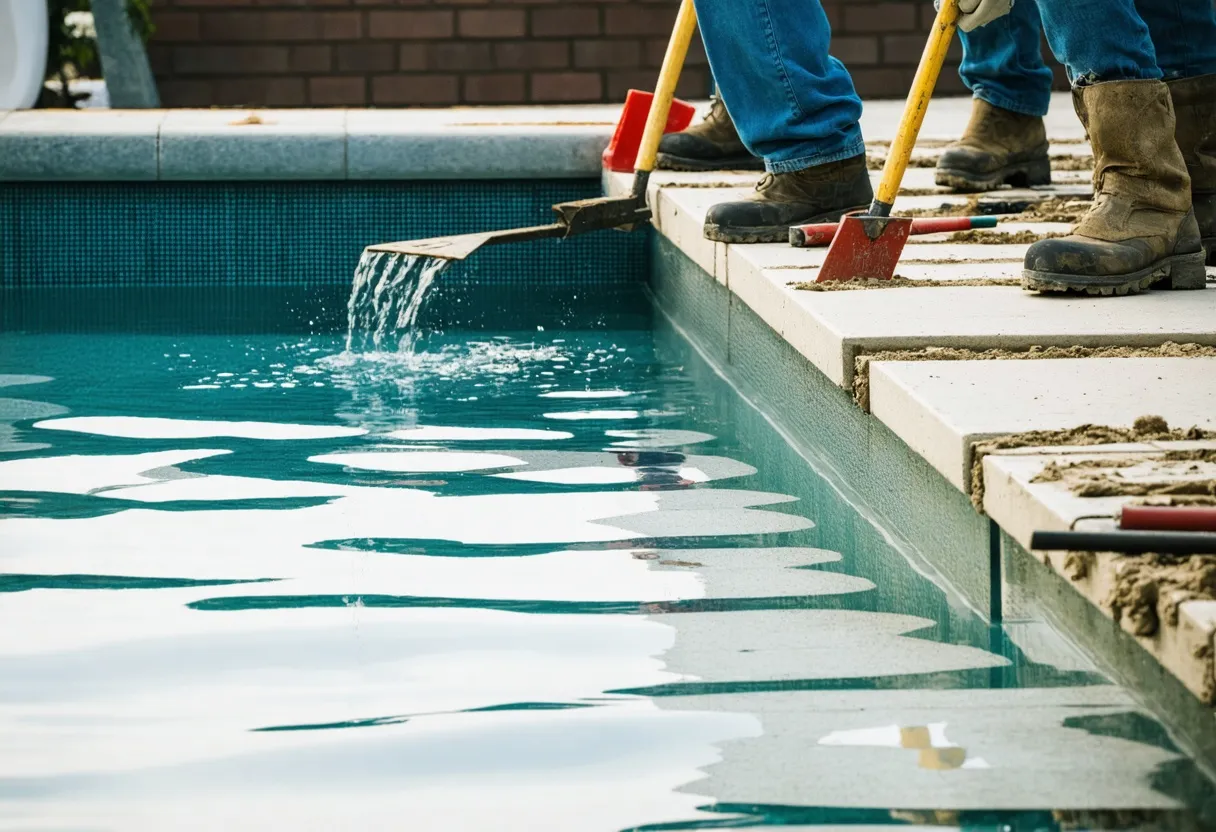
Commercial and HOA pool construction in Greenville, SC answers to a different set of rules than a backyard pool ever will. The moment a pool serves more than one household — an amenity center, a swim club, an apartment community, a hotel — South Carolina treats it as a public or semi-public facility, and that single classification change cascades into engineered plans, state health-code review, ADA entry requirements, and a construction budget that has to account for Greenville's clay-and-rock ground before a shovel goes in. This page is written for the audience actually making that call: HOA board members comparing bids, property managers scoping a capital project, and commercial owners who need a pool built to survive Upstate soil and pass a state inspection on the first try.
Pool Construction Greenville builds and renovates gunite, vinyl, and fiberglass pools for associations and commercial properties across the Greenville area, and the angle below is deliberately narrow: how Piedmont terrain and Greenville's overlapping permitting jurisdictions should shape your soil assessment, your permit strategy, your pricing tiers, and how you structure financing — not a general overview of pool types.
01Who This Page Is For — And What Changes Once a Pool Serves More Than One Household
If you sit on an HOA board, manage a multifamily or hotel property, or oversee a swim club anywhere from the City of Greenville out to Simpsonville, Mauldin, or Greer, the pool project in front of you is legally and financially a different animal than the residential pool your neighbor built last year. A residential pool answers to one household and one building permit. A community or commercial pool is reviewed by South Carolina's public-pool health authority in addition to your local building department, and that review covers things a homeowner never has to think about: minimum water turnover rates for the pool's classification, structural plans stamped for occupancy load rather than a single-family design, at least one ADA-compliant entry point, and code-specified depth markers, signage, barrier fencing, and safety equipment.
None of that is optional, and none of it is negotiable on price. What is negotiable — and where boards either save real money or absorb an expensive surprise — is whether the contractor pricing your project has actually accounted for Greenville's specific ground conditions and its patchwork of local jurisdictions before writing a number down. A site off Congaree Rd and a site in unincorporated Greenville County can carry meaningfully different excavation costs and permit timelines even though they're a few miles apart, simply because of what's under the soil and which building department reviews the plans. That's the gap this page is built to close.
The rest of this page assumes you're comparing bids, not shopping for the cheapest number. A complete proposal for a project this size should look different from a residential quote in specific, checkable ways — which is what the next section walks through.
02What a Complete Commercial or HOA Bid Should Actually Include
03Piedmont Clay, Buried Rock, and Two Separate Permit Tracks: The Risk Boards Don't See Comi
Greenville sits in the Piedmont, and that geography creates two distinct risks for a project this size — one underground, one administrative — that a generic regional estimate simply won't catch.
The ground itself
Upstate soil is dominated by red clay that expands and contracts noticeably with moisture, which matters enormously for a poured concrete structure expected to hold thousands of gallons and heavy shared foot traffic for decades. It's also common across Greenville-area sites, including lots along corridors like Congaree Rd, to hit partially weathered rock — locally known as saprolite — at shallow depth, sometimes well before excavation reaches the planned pool floor. Neither condition is unusual here, but both change excavation method, foundation design, and cost depending on exactly where on a given lot the pool sits. A proposal priced off a regional average rather than a site-specific geotechnical read is, in practical terms, an incomplete proposal — encountered rock during excavation is the single most common source of budget overruns on Upstate community pool projects, and it's avoidable with an assessment done up front rather than discovered mid-dig. Grading matters just as much: much of the Piedmont has real natural slope, and a deck plan that doesn't account for it will direct stormwater back at the shell or into neighboring units, creating settlement and drainage complaints that outlast the warranty.
The permitting map
Greenville's metro area is not one building department — it's several. A project inside the City of Greenville follows a different local review path than one in unincorporated Greenville County, and that path changes again in Simpsonville, Mauldin, Greer, or Fountain Inn, each of which issues its own permits rather than deferring to the county. Projects further out toward Taylors, Anderson, or Spartanburg fall under entirely different county jurisdictions with their own inspectors and submittal requirements. Layered on top of whichever local department applies, every HOA and commercial pool also needs sign-off from South Carolina's state environmental health authority as a public or semi-public facility — a review that runs independently of local zoning and building approval and evaluates the engineering plans on its own timeline. Missing either layer, or assuming one permit covers both, is the most common reason a Greenville-area HOA pool project stalls. Running the local and state tracks in parallel from day one, instead of sequentially, is typically the difference between a permitting phase measured in weeks and one measured in months — and it's a fair question to ask any contractor bidding your project directly: which jurisdiction does your site fall under, and how are you handling both tracks at once?
04From Signed Contract to State Inspection: How a Community Pool Project Actually Moves in t
A geotechnical read of the clay and rock conditions on your specific lot, plus a drainage survey and utility locates, feeds directly into the excavation and foundation numbers rather than a generic regional estimate.
Layout and ADA entry design get finalized alongside structural plans stamped for occupancy load, then submitted to your local building department and the state public-pool health authority at the same time, not one after the other.
Excavation is shaped to the engineered plan with the site's clay and rock conditions already factored in, structural rebar and circulation plumbing go in before the shell, and the gunite or fiberglass vessel is formed and cured.
Pumps, filtration, and heaters are sized to hit the pool's required turnover rate, the interior finish and tile line go on, and deck, fencing, and ADA-compliant pathways are built out around the vessel.
The pool is filled and chemistry balanced, then the state health inspector signs off before residents or the public can use it — boards should build scheduling buffer in here, since a fixable first-inspection issue like signage or fencing can push an opening date if it isn't caught beforehand.
05Pricing Tiers and How Your Financing Choice Should Shape the Contract
Commercial and HOA pool pricing runs well above residential work because of vessel size, engineered plans, dual-jurisdiction permitting fees, and commercial-grade equipment — and it varies widely by pool type, size, site conditions, and how many features a board wants included. Rather than lead with a single number that won't hold up across different lots, a complete bid should walk your board through the real cost drivers as tiers: excavation and site work shaped by clay and rock conditions, shell type and size, engineering and permitting fees across both jurisdictions, an equipment package sized to your turnover requirement, interior finish choice, decking and hardscape scope, and any add-ons like an integrated spa or shade structures. Each of those tiers moves independently, which is exactly why a soil assessment and a clear scope have to come before a number gets attached to a contract.
Very few HOAs pay for a new pool or major renovation entirely from reserves, and most commercial owners finance construction as part of a broader capital plan. The paths that come up most often for boards and property managers in this market are reserve-fund allocation paired with a special assessment when a reserve study has been building toward a pool replacement; HOA-specific construction loans that spread cost across the membership over a fixed term instead of requiring a lump-sum assessment; commercial construction loans tied to a property's broader financing for apartment communities, hotels, and other commercial ownership structures; and phased construction contracts that split scope — shell and equipment first, deck and hardscape later — across separate budget cycles. Financing choice isn't a detail to settle after design is finalized: it affects how the contract itself should be structured and how payment milestones line up with the construction phases above, so it's worth reviewing before final design is locked rather than after.
06Commercial and HOA Pool Construction: Questions Boards Actually Ask
Once a pool serves more than one household it's generally treated as a public or semi-public facility, which brings in requirements a residential pool never faces — engineered plans stamped for occupancy load, minimum water turnover rates, an ADA-compliant entry, code-specified signage and safety equipment, and an independent state health inspection before it can open.
Piedmont red clay expands and contracts with moisture, and shallow weathered rock is common across Greenville-area lots, including sites along corridors like Congaree Rd. Both directly change excavation method and foundation cost, so a site-specific assessment — not a regional average — should be priced into the base bid, not added later as a change order.
Yes. The City of Greenville, unincorporated Greenville County, Simpsonville, Mauldin, Greer, and Fountain Inn each run their own local review process, and sites further out toward Taylors, Anderson, or Spartanburg fall under different county jurisdictions entirely. Every project also needs a separate state public-pool health review regardless of which local department applies, so the two tracks need to run at the same time, not back to back.
Most HOA and commercial pools in the Upstate use gunite because it handles custom shapes, larger sizes, and Piedmont soil conditions over a multi-decade lifespan. Fiberglass can suit a smaller amenity pool where installation speed matters, and vinyl liner tends to fit tighter-budget renovations with the understanding that the liner is a recurring replacement cost.
Common paths include reserve-fund allocation combined with a special assessment, HOA-specific construction loans that spread cost over time, commercial construction loans tied to a property's broader financing, and phased contracts that split scope across budget cycles. Which one fits depends on your reserve study status and the board's appetite for a lump-sum assessment versus financed payments.
Ask for current South Carolina contractor licensing and PHTA certification tied to the specific individuals designing and building your project, confirm it independently rather than taking a website claim at face value, and make sure the bid includes a site-specific soil assessment and a dual-track permitting plan rather than treating either as an add-on.
07Verify the Credentials Before the Contract, Not After
A commercial or HOA pool is a shared, six-figure asset your board is trusting to one contractor. Ask directly for current South Carolina contractor licensing and PHTA certification for the people who will actually design and build your project, and confirm it independently rather than relying on a logo. Get your site's soil conditions, jurisdiction, and financing plan on the table first, and the pricing conversation gets a lot more accurate.
Get your free quote
Tell us about your property and we'll follow up with next steps — no pressure, no obligation.
Ready to see what your site needs?
Get a free, no-obligation quote built around your property's actual conditions.